What PPDA measures, and how to read it
Passes per defensive action is the simplest number for how hard a team presses. At Women's Euro 2025, Spain allowed opponents the fewest passes before stepping in.
Some teams chase the ball the moment they lose it. Others drop back and wait. PPDA, short for passes allowed per defensive action, puts a number on that difference.
The calculation
PPDA counts how many passes the opponent makes in their own part of the pitch for every time your team steps in to win the ball there.
PPDA = opponent passes in their own 60% of the pitch ÷ your defensive actions in that same area
Defensive actions here are tackles, interceptions and fouls. The area is the opponent’s 60% of the pitch, measured from their own goal line, so most of the midfield counts but deep defending in your own half does not.
Lower PPDA means a more intense press. A PPDA of 8 means the opponent managed about eight passes before your team made a tackle, interception or foul. A PPDA of 25 means they could pass freely for a long time first.
Women’s Euro 2025, team by team
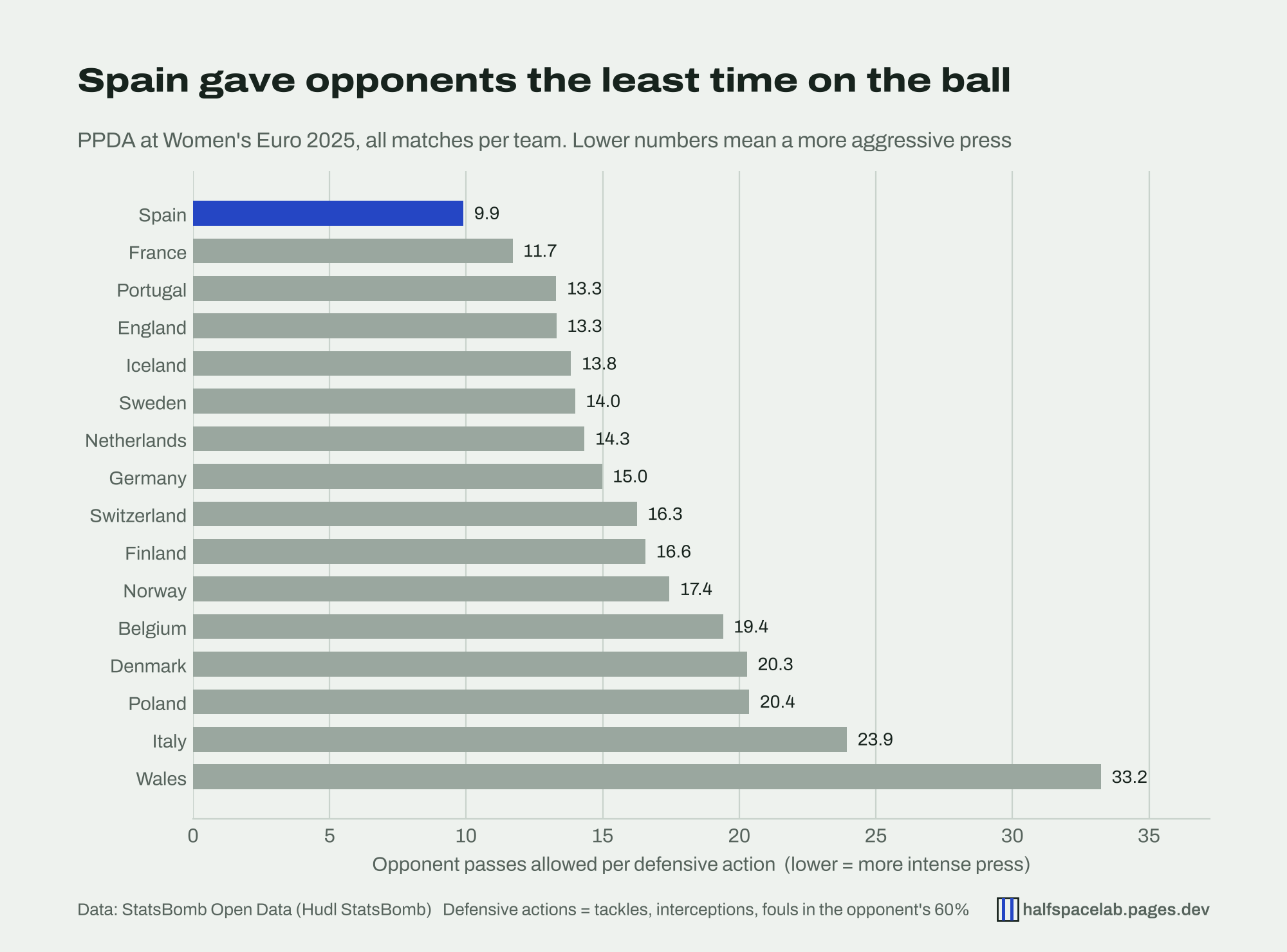
Spain allowed opponents 9.9 passes per defensive action, the lowest of the 16 teams, with France next at 11.7. At the other end, Wales let opponents make 33.2 passes for every action, more than three times as many as Spain.
How to read it carefully
- It measures intensity, not quality. A low PPDA says a team tried to win the ball high up. It doesn’t say whether that worked.
- Game state changes it. A team protecting a lead often sits deeper, so its PPDA rises. A team chasing a game presses more.
- Opponents matter. Pressing a side that likes to keep the ball produces different numbers from pressing one that plays long.
- Definitions vary. Data companies differ on which actions count and where the line on the pitch is drawn. Compare PPDA from the same source and method, as in the chart above, not across websites.
Why it’s useful
PPDA is a quick way to tell pressing teams from deep-sitting ones without watching every match. Combined with where a team wins the ball back and what it creates afterwards, it’s the starting point for most analysis of pressing.
How this was made: all 31 matches of Women’s Euro 2025 from StatsBomb Open Data, extra time included. Opponent passes are counted when they start in the opponent’s own 60% of the pitch; defensive actions are tackles, interceptions and fouls committed in the pressing team’s attacking 60%. Each team’s figure is total passes divided by total actions across its matches.