What a half-space is, and why this site is named after one
The two in-between lanes of the pitch give a player the passing angles of the centre with less traffic, which is why coaches obsess over them.
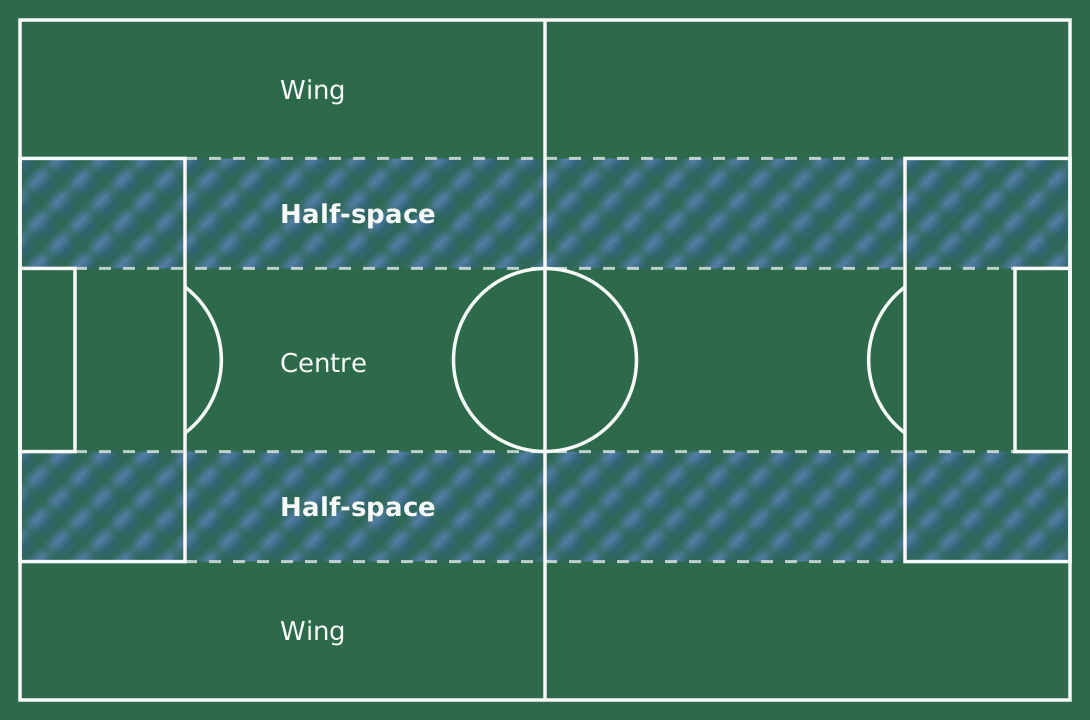
Draw two lines down the pitch along the edges of each penalty area, and two more along the edges of each six-yard box. You now have five lanes: a wing on each side, the centre, and between them the two half-spaces.
Why the in-between lane matters
A player on the wing has the touchline on one side, so half of his options are gone. A player in the centre can pass anywhere, but the centre is where defenders gather.
The half-space sits between the two. A player there can still pass inside, outside, forward and back, but usually with fewer opponents close by. Because he is already at an angle to goal, his body faces the play diagonally and he can see both the box and the flank without turning.
What to watch for
- Free eights and inside forwards drifting into the half-space between the opposition’s full-back and centre-back.
- Overlaps and underlaps: a full-back running outside or inside a teammate who holds the half-space.
- Cut-backs: low passes from the edge of the six-yard box, which is the inside edge of the half-space.
How this site uses data to look at it
In later pieces, event data lets us count where passes, carries and shots start and end, lane by lane. That turns “this team attacks through the half-spaces” from an impression into something we can measure and compare.
How this was made: the lane diagram is drawn to the real pitch markings (105 × 68 m). No match data is used in this piece.