How to read a pass network
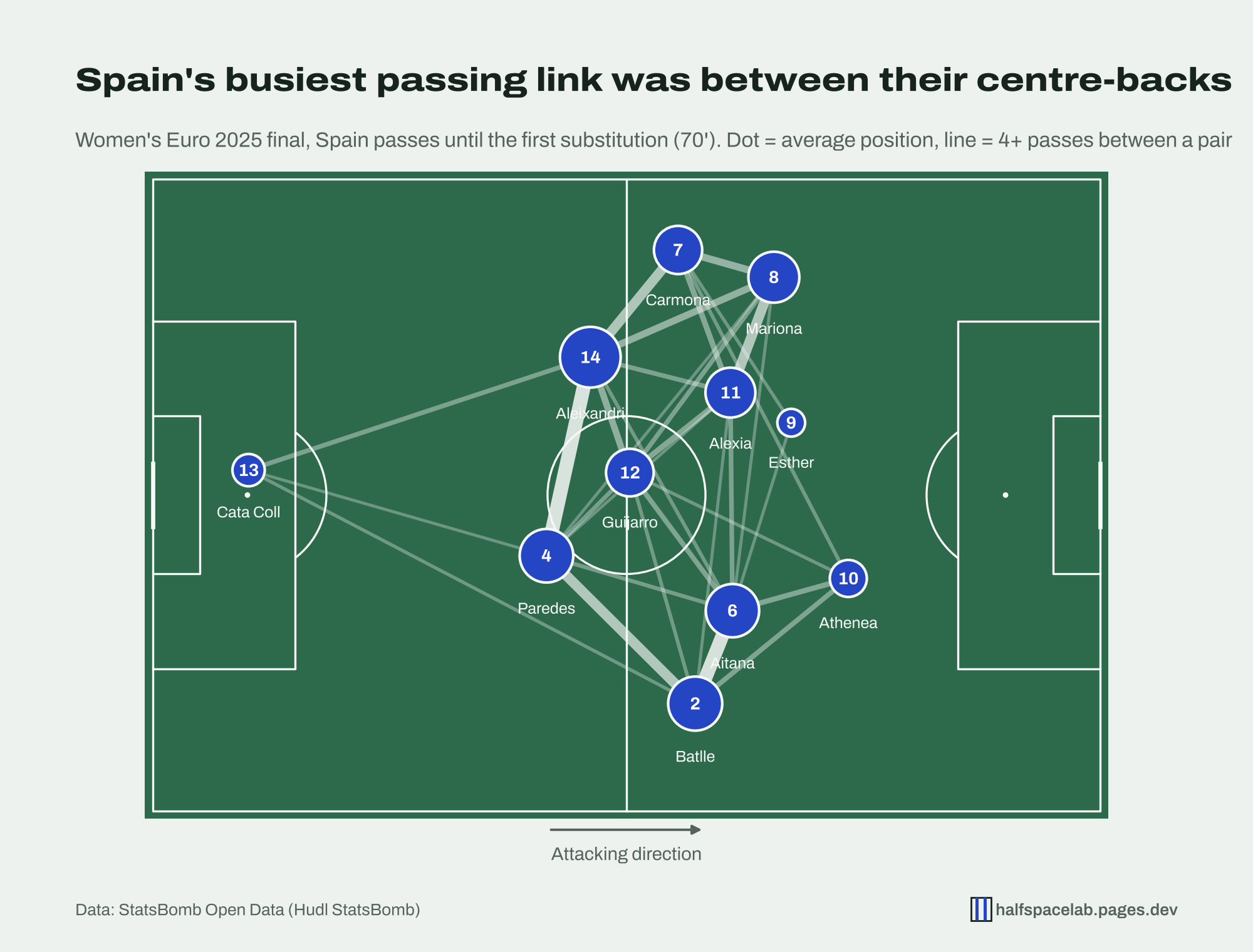
Dots for where players stood, lines for who passed to whom. Spain's network from the Euro 2025 final shows a team built on its centre-backs and right side.
A team sheet tells you the formation. A pass network shows how the team actually played: where each player spent their time on the ball and which partnerships the passing ran through.
The parts of the chart
Dots are players, placed at their average position: the mean of every spot where they passed the ball or received it. Bigger dots mean the player was involved in more passes.
Lines join two players who passed to each other at least four times, in either direction. Thicker, brighter lines mean more passes between them.
The time window matters. A network only makes sense for one set of eleven players, so it usually stops at the first substitution. Here that was the 70th minute, covering 389 completed passes.
What this one tells us
- The busiest link was between the centre-backs. Paredes (4) and Aleixandri (14) exchanged 38 passes, the most of any pair. Spain recycled the ball across the back patiently before moving it forward.
- The right side was a highway. Aitana (6) and right-back Batlle (2) linked up 37 times, almost as often. Batlle’s average position is level with the midfield, a full-back playing high.
- The full-backs pushed on. Both Batlle and Carmona (7) sit further forward on average than defensive midfielder Guijarro (12).
- The striker was isolated. Esther (9) has the smallest dot of the outfield players and no thick lines. Most of Spain’s passing happened behind her.
Common traps
- Average positions blur movement. A winger who swaps sides halfway through will appear in the middle of the pitch, where they may never have stood.
- Only completed passes count. A team whose passes keep breaking down shows a thin network even if it tried to play through the same players.
- It’s possession-heavy. A team that had the ball for long spells will always look busier than one that sat deep. Compare shapes and partnerships, not just how thick the lines are.
How this was made: Spain’s completed open-play passes in the final against England, 27 July 2025, until the first substitution (70th minute), from StatsBomb Open Data. Set-piece passes such as corners and free kicks are excluded. Positions are averages of pass and reception locations.